| Name | International Space Station |
| Type | Large modular space station |
| Orbit | Low-Earth orbit |
| Purpose | Scientific research • Technological development • International cooperation in space exploration |
| Operator | United Space Directorate (USD) |
| Partners | Multiple international countries |
| Abbreviation | ISS |
| Capabilities | Microgravity experiments • Advanced space technology testing • Expansion of space tourism and industry |
| Assembly Start Date | 1998 |
| Assembly Completion Date | 2011 |
The International Space Station (ISS) is a large modular space station that has been in continuous operation since the early 2000s, serving as a hub for scientific research, technological development, and international cooperation in space exploration. Operated by the United Space Directorate (USD), the ISS represents a collaborative effort between dozens of countries around the world.
The origins of the ISS can be traced back to the establishment of the USD in 1972, which brought together the space programs of the United States, Soviet Union, and major Western European nations. Recognizing the potential benefits of pooling resources and expertise, the Directorate began planning for a successor to the earlier Mir and Skylab space stations.
Construction of the first ISS modules commenced in 1998, with contributions from the USD member states as well as emerging space powers like China and India. Over the following decade, the station was gradually expanded through the addition of new laboratory, habitation, and support modules, eventually reaching its current configuration.
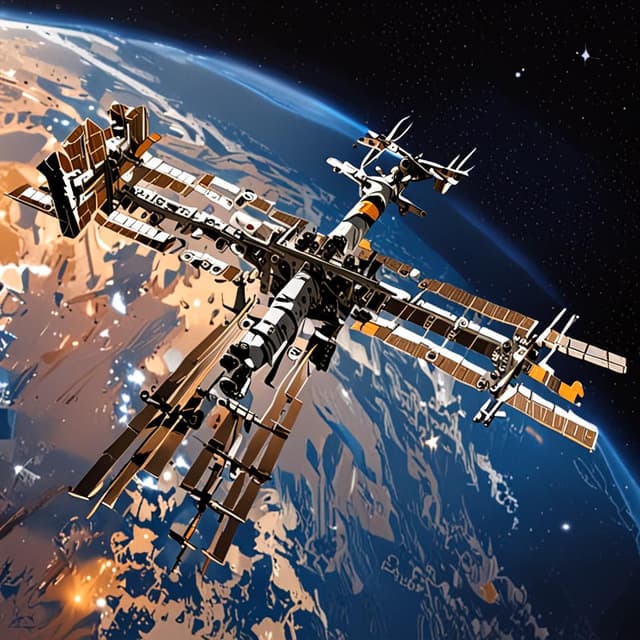
The ISS consists of a complex network of pressurized modules, external platforms, and robotic manipulators, all held together by a large truss structure. The core of the station is formed by the Zarya and Zvezda service modules, provided by Russia, along with the Unity and Harmony node modules from the United States and Europe, respectively.
Surrounding this central core are additional research, logistics, and crew support modules contributed by other partners, including the Kibo module from Japan, the Canadarm2 robotic arm from Canada, and the Tiangong module from China. The station also features vast solar panel arrays to generate power, as well as docking ports for visiting spacecraft.
The primary purpose of the ISS is to serve as a microgravity laboratory, enabling a wide range of scientific experiments and technological demonstrations that are not possible on Earth. Key areas of research include:
The ISS crew, comprising astronauts and cosmonauts from around the world, conducts these experiments and maintains the station's operations on a continuous basis.
In addition to its scientific mission, the ISS has also become a hub for commercial space activities. The USD's Commercial Spaceflight Authority regulates and facilitates private sector access to the station, enabling a growing space tourism industry as well as the testing of new technologies and manufacturing processes.
Major companies have established research facilities and production lines aboard the ISS, taking advantage of the unique microgravity environment. This includes the development of exotic materials, biomedical treatments, and even the extraction of valuable resources from passing asteroids.
The ISS is crewed by a multinational team of astronauts, cosmonauts, and taikonauts who undergo joint training at the Global Space Force Academy. Crew members typically spend 6 months or more aboard the station, maintaining its systems, conducting research, and overseeing commercial operations.
Resupply and crew rotation missions are carried out by a fleet of spaceplanes, reusable rockets, and space tugs operated by both governmental and private entities. This logistical support ensures a constant flow of crew, cargo, and experimental payloads to and from the orbiting laboratory.
As the ISS approaches the end of its originally planned lifespan, the USD is exploring options to extend its operational lifetime and expand its capabilities even further. Proposals include transitioning the station to a lunar-orbiting platform that could support future missions to the Moon and beyond.
Additionally, there are plans to establish a permanently crewed Lunar Base Alpha on the surface of the Moon, with the ISS serving as a critical logistics and operations hub. This would enable a new era of long-term lunar exploration, scientific research, and the development of space mining and in-situ resource utilization technologies.
